> For the complete documentation index, see [llms.txt](https://docs.world3.ai/world3/llms.txt). Markdown versions of documentation pages are available by appending `.md` to page URLs; this page is available as [Markdown](https://docs.world3.ai/world3/how-to-guides/ai-agent-portal/core-features/task-management.md).
# Task Management
## Overview
The Task Board allows you to organize and manage tasks your Agent creates. There are two types of tasks you can set up:
1. **Scheduled Tasks**: Time-based tasks that can be one-time or recurring
2. **Long-term Tasks**: Goal-oriented planning with multiple sub-tasks
## Scheduled Tasks
Scheduled tasks are time-based reminders that can be either one-time or recurring.
### Types of Scheduled Tasks
* **One-time Task**: Single execution task (e.g., "Send a tweet about the latest crypto news")
* **Recurring Task**: Repeated on a defined schedule (e.g., "Send an email at 3 PM every day")
### Creating Scheduled Tasks
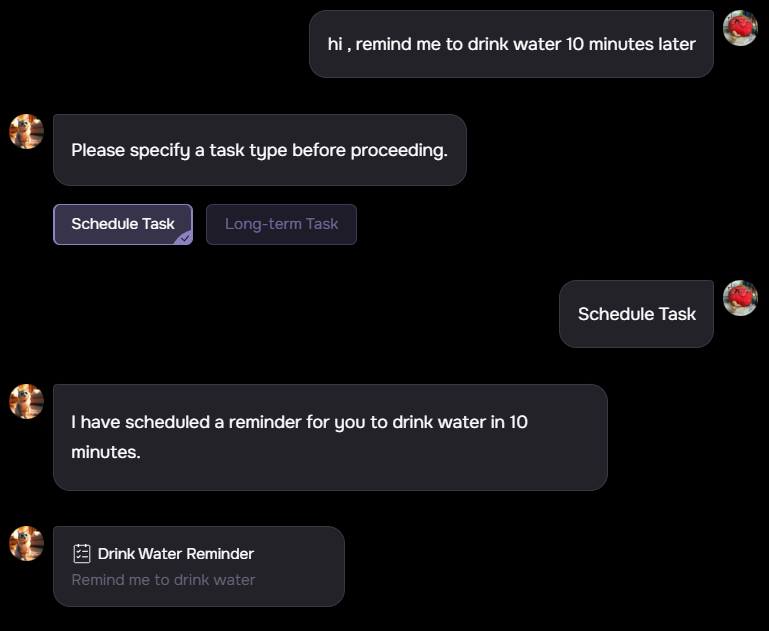
**Example instructions:**
* "Remind me to drink water in one hour"
* "Please remind me to send an email at 3 PM every day"
**Workflow:**
1. Input the instruction
2. Click **Schedule Task**
3. Agent will process and create the task
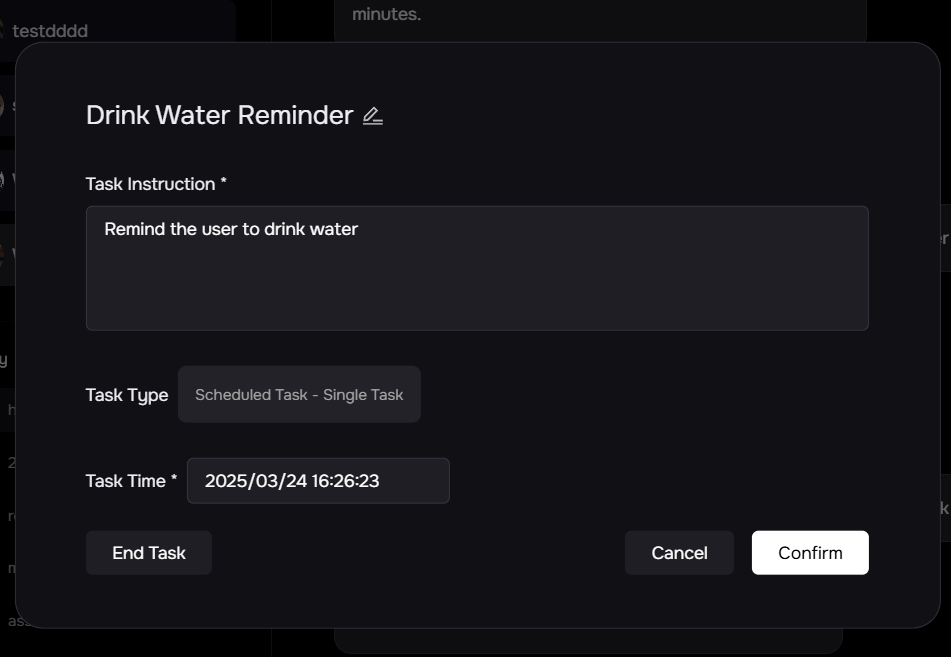
4. View and edit task details:
* Task Name
* Task Instruction
* Task Time
* Task Type (automatically assigned, not editable)
* Click **End Task** to cancel the task
## Long-term Tasks
Long-term tasks are goal-oriented planning tasks that can generate multiple sub-tasks to achieve a specific objective.
### Creating Long-term Tasks
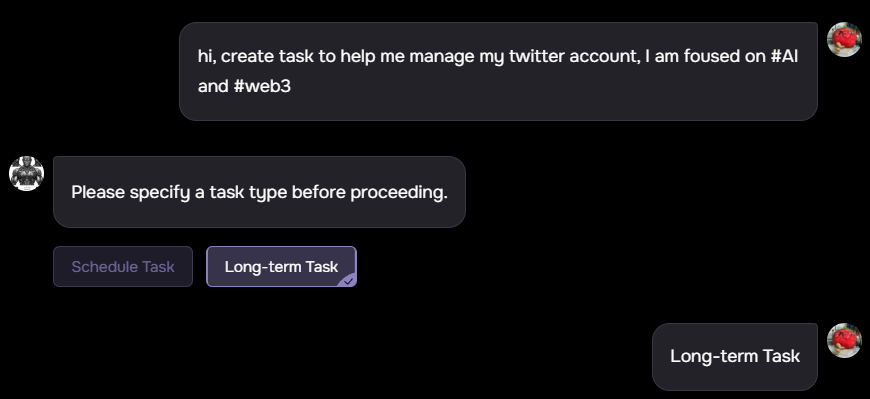
**Example instructions:**
* "Help me operate my Twitter account. I am focused on #AI and #Web3"
* "Please help me plan a Twitter operation. Aim to increase 1,000 followers"
**Workflow:**
1. Input the instruction
2. Click **Long-term Task**
3. Agent will process and create the task
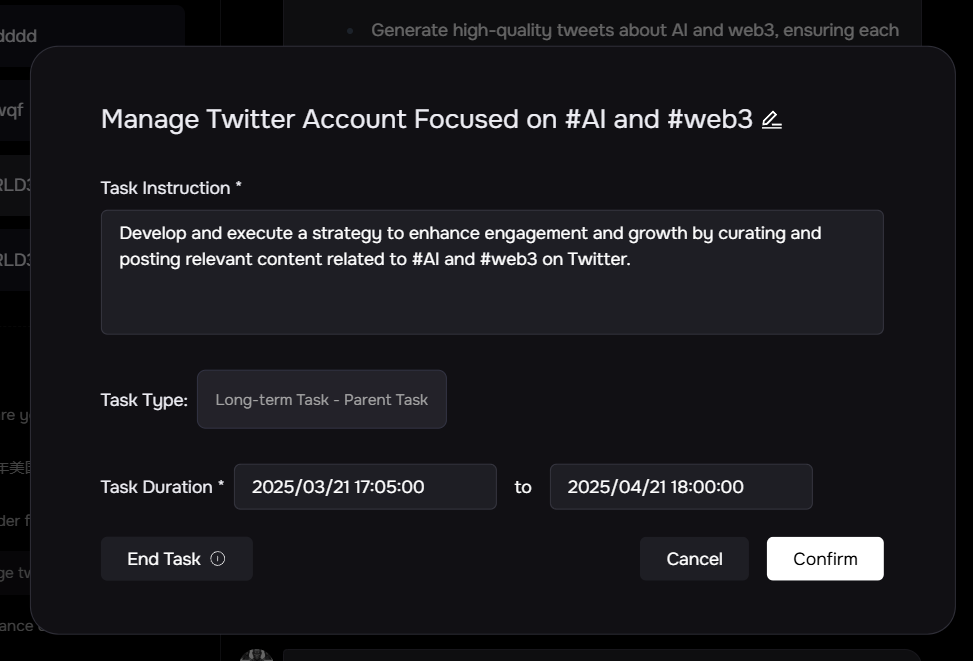
4. View and edit task details:
* Task Name
* Task Instruction
* Task Time
* Task Type (auto-assigned)
* Click **End Task** to stop the process
### Task Hierarchy
Long-term tasks follow a hierarchical structure:
* **Parent Task**: Main goal or long-term objective
* **Sub-task**: Specific actions generated from the parent task
{% hint style="warning" %}
**Note**: Ending the parent task will automatically terminate all associated sub-tasks.
{% endhint %}
## Notifications
### Execution Notification
After the agent executes a task, the user will receive a notification:
* After completing a task, the agent will proactively provide feedback in the session where the task was originally assigned.
* After each task is executed, a task session will automatically appear, displaying a notification along with the task logs.
### Notification Center
The Notification Center keeps you updated on task execution:
* Displays task execution updates from the Agent
* Click a notification to view task details in the TaskBoard
## Next Steps
* [Learn about Knowledge Packs](/world3/how-to-guides/ai-agent-portal/core-features/knowledge-packs.md) to enhance your agent's expertise
* [Explore available Skill Plugins](/world3/how-to-guides/ai-agent-portal/core-features/skills.md) to expand your agent's capabilities
.png?alt=media&token=42458288-920d-4018-be9c-191d081ae747)
.png?alt=media&token=d489b22d-4a47-4a04-be53-2419643fd4ea)
.png?alt=media&token=9416ae9e-2616-4581-8113-3df0459a32e9)
.png?alt=media&token=95db671e-1282-4cce-88d0-907d2976c9a7)
.png?alt=media&token=598d457b-892c-4866-bc55-79ef2aa22e6a)